play free ~ dream big
We create spaces for free, child-led play.
Indoor and outdoor.
For cities, galleries, events or institutions.

↑ back to top ↑
Nami Blocks
Modular play environments for shared interiors.
Open-ended play. Spatial integration. Institutional durability.


Modular play environments for shared interiors
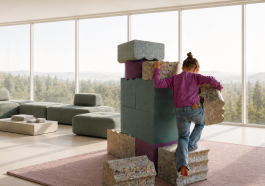
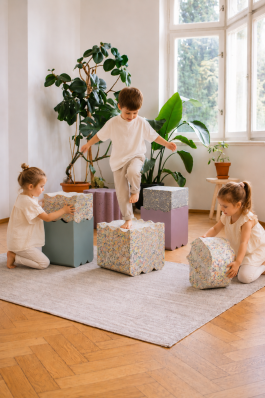
Nami Blocks is a modular soft-play system for spaces where children and adults coexist:
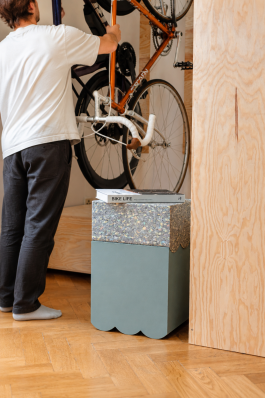
hotels, cafés, galleries, waiting areas, cultural and educational institutions.
It is not a toy, and not a fixed play scenario.
It is a flexible spatial system that supports open-ended play, movement, and social interaction.
Children almost never use environments the way adults imagined.
Nami Blocks is designed around that reality.
Designed to belong
Many children’s spaces are still treated as separate, brightly colored corners.
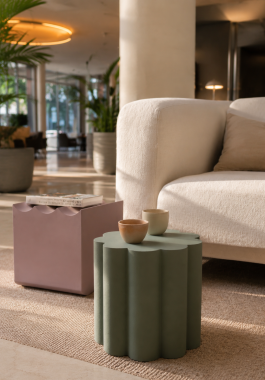
Nami Blocks offers another approach: a play environment that becomes part of the architecture around it.
The system integrates into shared interiors without losing its play value.
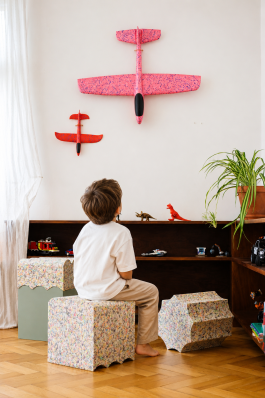
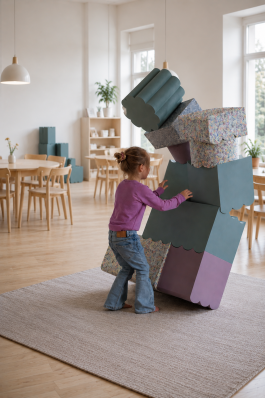
The same modules can support different forms of interaction depending on age, context and configuration.
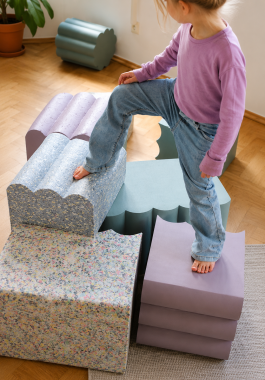
Children can sit, climb, build, balance, hide, negotiate and invent their own rules.
There is no single correct way to use Nami Blocks. That is the point.
Nami Blocks is made from recycled PUR foam and finished with a seamless polyurethane coating.
Unlike conventional stitched soft-play covers, the surface is seamless, durable and easy to clean.
Suitable for intensive institutional use.
Nami Blocks is currently in development and pilot validation.
We are preparing prototype production, institutional testing, certification and commercial launch.
For pilot projects, institutional partnerships or investment conversations: hello@naminami.studio


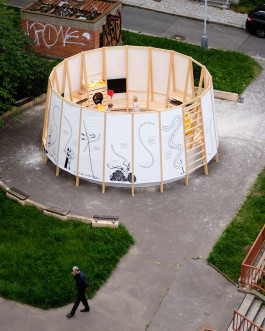
ArchDaily: Nami Play Pavilion
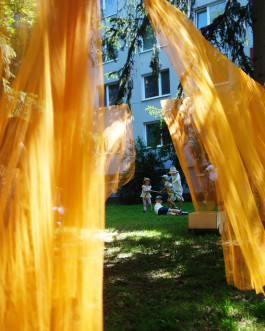
Designboom: Translucent drapes encircle forest floor for Nami nami's Concéntrico installation in Spain
Forbes česko: Když se galerie změní v pískoviště
Material Times: Rozhovor: Svobodná hra, udržitelné materiály a kreativní přístup
Týdeník Echo 24: Mít si kde hrát
Stavba web: Místo dětí: prožitková výstava, která podněcuje kreativitu
DesignNews: Rozhodly se skloubit studium a mateřství...
DesignMag: Na Žižkově mezi paneláky vzniklo experimentální hřiště
CAMP Magazín: Dobrodružná hřiště a školní plácky. Jak vypadají nová hřiště v Praze?
Material Times: Inspirační výlet za svobodnou hrou
www.naminami.studio
hello@naminami.studio
+420 774 110 889
follow us on instagram @nami_nami_studio
Do you remember how you used to play as a child?
Running outside all day with friends, a piece of bread in your pocket — and nothing more. A few stones, some sticks, whatever you found lying around – that was enough for a great adventure.
Today’s children don’t have that freedom. They play on fenced playgrounds with rubber floors, with plastic toys that break and get replaced. They play on screens, always close to their parents — because we’re afraid to let them out of sight.
Why free play in cities matters:
~ builds autonomy, creativity and socio‑emotional skills across ages and abilities
~ activates underused streets and plazas with low cost & high impact
~ fosters intergenerational encounters; supports inclusion and community ties
~ can be customized to suit different spatial and social contexts

What we do:
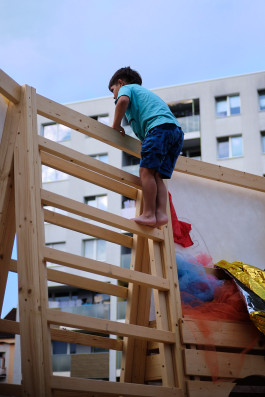
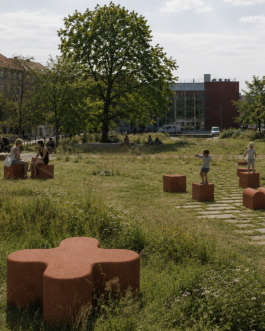
~ design and creation of child‑led free play in public space (indoors & outdoors)
~ installations built from adaptable, low‑tech, often natural or reused materials
~ from pop‑ups and installations to alternative playspaces
~ loose‑parts approach: open‑ended elements invite imagination and creativity
~ grounded in ongoing academic research (Faculty of architecture at CTU Prague)
~ we co‑create with communities, municipalities, galleries and events

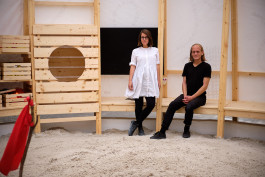
Nami Nami Studio was founded by product designer Eduard Herrmann and architect Klára Koldová.
~ focus: experimental design bridging architecture, play and sustainability
~ based in Prague, Czech Republic; active internationally
The studio focuses on tailor-made experiential interventions and installations for children’s play. At the heart of each design lies freedom of play, creativity, and imagination. The result is a series of playful spaces and magical micro-worlds that serve as alternatives to conventional playgrounds and playrooms, which typically rely on standardized equipment and lack deeper engagement with children’s development and creativity.
~
Eduard Herrmann studied product design at the Academy of Arts, Architecture and Design in Prague (UMPRUM). He designs products for both industrial and craft production, as well as artistic interventions and exhibition architecture. Previously, he collaborated with Matěj Coufal under the label Herrmann&Coufal (2014–2023). Since 2020, he has been pursuing a Ph.D. at UMPRUM, focusing on sustainability, low tech, and reuse in design. In the 2022/23 academic year, he co-led the Planet B module on sustainability and civilizational issues together with Klára Peloušková at the same institution.
Klára Koldová graduated from the Faculty of Architecture at the Czech Technical University in Prague (CTU) and the University of Bath in the UK. She previously worked at the architectural studio DDAANN (2016–2020) and now designs primarily interiors and renovations under her own name. Since 2021, she has been conducting doctoral research at the CTU Faculty of Architecture, focusing on places for children’s play in urban public space.